KyberBot in a robot: an assistant with mass
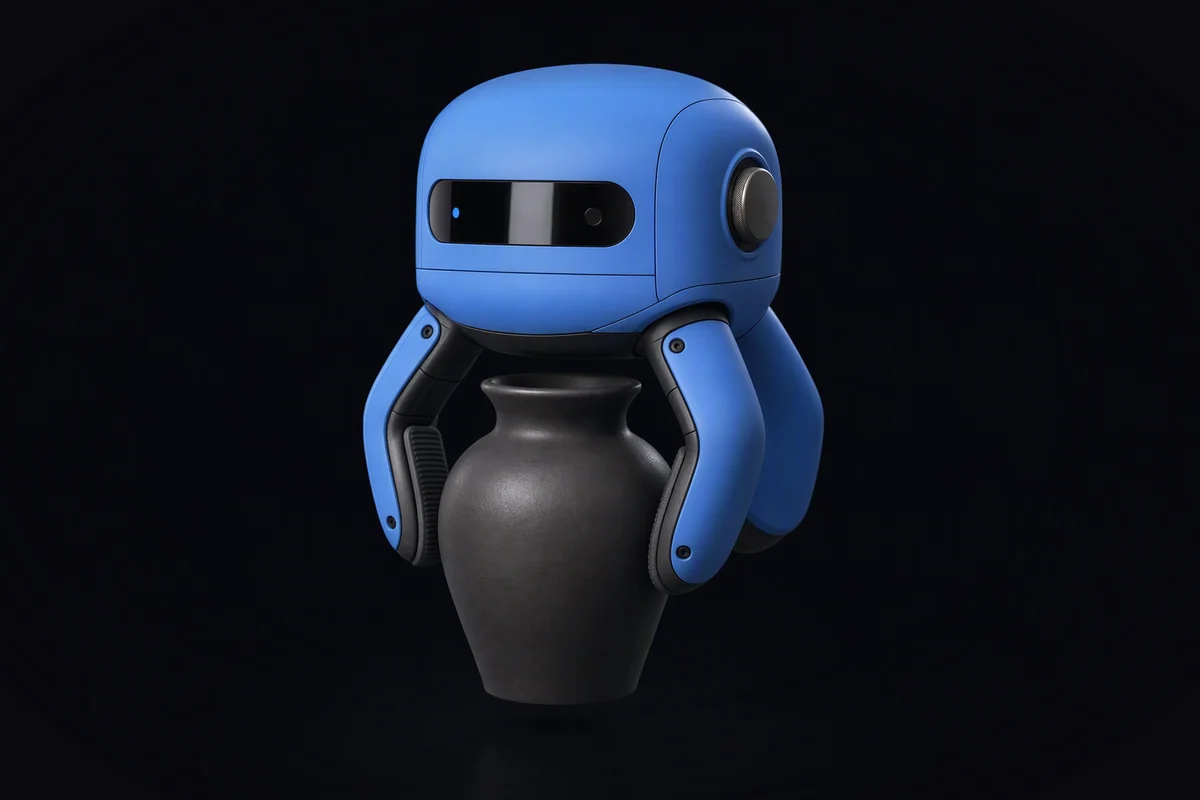
You ask the assistant to tidy the hallway before the guests arrive. On a phone, a misunderstood request costs you an awkward message or a wrong booking. In a robot it costs a vase on the floor, shoes pushed down the stairs, or a machine rolling at full speed into the room where a child is asleep. The request was the same. The price of getting it wrong was not.
That is the whole difference between an assistant and an assistant with mass, and it is why KyberBot in a robot is the same assistant with something important added.
The real cause: mistakes used to be cheap
Assistants grew up making mistakes made of words. A wrong answer is corrected by the next message. Everything about how they are built, from the way they plan to the way they are tested, assumes that a mistake means a retry.
Mass breaks that assumption. A motion cannot be taken back. And the cleverer the planner, the more tempting it is to let its judgement be the only thing between an instruction and an actuator. That is the mistake: the part of a robot that decides what to do is not the part that should decide what it is allowed to do.
How it goes wrong
The planner as the safety layer. If the only thing stopping a motion is the model deciding it is a bad idea, then a persuasive enough instruction or a confident enough mistake goes straight to the motors.
Permissions copied from the screen. An assistant trusted to book a table should not, by extension, be trusted to open a door, carry a hot pan or cross a room with a dog in it. Physical permissions need rules of their own.
The map is a claim. Homes change by the hour: a chair moved, a bag on the floor, a child walking up to the robot to see what it is doing. We wrote about this gap on the factory floor in The gap between simulation and the floor, and a home is harder.
The network as a leash. When the link drops, a robot that stops dead is useless and one that carries on with no boundary is dangerous. Both are common. When the network drops covers the ground between them.
No receipt. Something gets broken and nobody can say what the robot believed, which rule applied or why it thought the motion was fine.
What KyberBot carries into a robot
KyberBot is pre-launch, and so is everything described here; this is the design we are building it to.
The same assistant. A robot running KyberBot answers to your identity and works from your memory, so it knows the hallway, the guests and the child asleep upstairs. One assistant across every body is the subject of One assistant, many bodies.
A harness below the planner. The envelope (where the machine may go, how fast, with how much force, which tasks in which rooms at which times) is declared as data and enforced below the planner. A plan that violates it never becomes motion, however well it is argued. The details are in What a harness actually does.
A homeostat. Set points on speed, force, proximity and how sure the robot is of where it is. When its agreement with the world drops, it slows, stops or hands control back without waiting to be asked.
Motion on the ask-first list. Anything outside the standing envelope you have approved waits for your yes, the same as a payment or a message in your name. “Move the sofa” is a question before it is a motion.
A receipt for every motion. What was asked, what the robot believed, which envelope applied and what it decided, written at the moment of decision. Every motion needs a receipt explains why; KyberAgent applies the same rule to software in Every step on the record.
Above certified safety, never instead of it. Emergency stops, safety-rated controllers and the standards behind them stay hard-wired. KyberBot sits above them and tries to make their job rare.
The body itself comes from the deck family: a KyberDeck Core module slides into a robot’s compute bay, which is why we say a robot is a deck with wheels.
A test you can run today
Take any robot you own or are thinking of buying: a vacuum, a lawn mower, a toy, a warehouse machine. Find the answers to four questions in its documentation or from its maker.
- What can it not do, even if told to? Not “it is smart enough”, but a list of limits.
- Where are those limits written down, and can you read them?
- What does it do when the network drops?
- Can you get a record of why it moved where it moved?
If the answers are about how clever the robot is rather than about what it cannot attempt, it has a planner and no harness. The point is not a less capable robot. It is a capable one that works inside limits you can read, test and change only on purpose. That is the gap KyberBot is being built to close: an assistant that knows you, in a body that is not allowed to guess.
- robots
- safety envelope
- harness
- home robots