What the assistant says aloud and what only to you
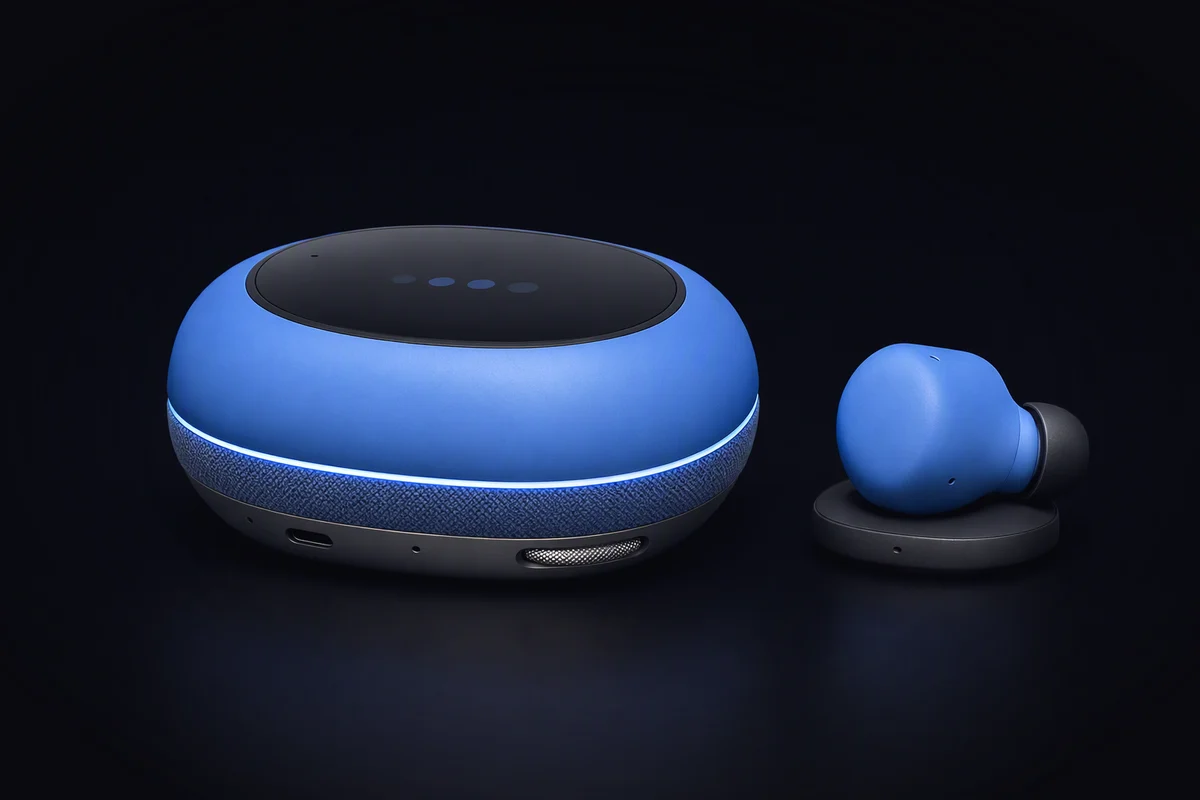
Tuesday morning, the kitchen is full. The assistant on the shelf says, in its clear and friendly voice, that your appointment at the clinic is at eleven and that you should bring the referral. Your parents-in-law look up from their coffee. You had not told them about the clinic. You had not decided whether you would.
Two hours later you are presenting to a client with the pocket deck on the table, and a message from your partner arrives. The deck reads the first line out loud, as it does at home. The room goes quiet in the specific way rooms go quiet when they have heard something they should not have.
Neither moment involved a breach or a bad actor. The assistant said exactly what you had asked it to say. It just said it to everyone.
The real cause: the channel was never part of the decision
An assistant that speaks treats voice as a volume setting, not a privacy setting. It decides what to say, and the question of where the words go, into a speaker for the whole room or into an earpiece for one person, is left to whichever device happened to receive the request. That is backwards. For a person, “what do I say and to whom” is one decision. A reminder about a medical appointment is not a secret from you, but it is from the room, and an assistant that cannot hold both ideas at once will keep choosing the room.
Where speaking goes wrong
Everything is public once it is audio. A speaker has no recipient. Whatever is said through it is heard by everyone within range, including people the assistant has never met and has no profile for. The private content of a reminder does not change; its audience does.
Previews that read the first line. The most sensitive part of a message is often its opening. Reading it aloud “so you do not have to look” is a convenience that assumes you are alone.
Confirmation as a leak. “Did you want me to move the therapy session?” is a reasonable question and a disclosure in the same breath. Asking before acting is right; asking out loud is a separate choice.
Context guessed from the device, not the situation. The pocket deck is the same device in your kitchen and in the client’s boardroom. If its speaking rule follows the hardware, it will behave at work the way it behaves at home.
Silence as the only alternative. Faced with the problem, most assistants offer one switch: mute. Then the useful reminders go unheard too, and you turn it back on, and the cycle repeats.
Shared spaces with several owners. In a household node the room is shared by design, and what is private for one person may be ordinary for another. A rule that fits one profile does not fit the room; which is why memories and policies have to be per person first, as the previous post argued in One home assistant, several people, separate memories.
What to design instead
KyberBot is pre-launch. The homepage promises an assistant that asks before anything sensitive and that lives in every KyberDeck form, from a card to a robot. What follows is how we intend that to apply to speech; these are design rules, not released settings.
Two kinds of channel, and the difference is structural. A private channel reaches one person: an earpiece, the glasses, a screen held in a hand. A public channel reaches whoever is there: the speaker on the shelf, the robot’s voice. The assistant knows which is which, because the device declares it, and the decision to speak includes the channel every time.
Sensitive content defaults to private. Health, money, messages from people, other people’s details and anything you have marked as yours go to a private channel when one is available. On a public channel the assistant says that there is something, not what it is: “you have a reminder for eleven”, and the rest when you ask on a channel that reaches only you.
The person sets the rule, in plain text. Which categories are private, which rooms count as shared, which hours are quiet, is a policy you can read and change, the same policy language that governs what the assistant may spend or send. It is not a mood and not a guess that improves with time.
Context is detected, then confirmed. The assistant can notice that it is not at home, that other voices are present, that the deck is on a table rather than in a pocket. It uses that to pick the safer channel. It does not use it to decide you are alone.
When unsure, it asks, on the private channel. The right fallback is not to stay silent and not to speak. It is a short question on the channel that reaches only you: “something private came in, say the word and I will read it”. If no private channel is available, it waits.
A test you can run today
Take the assistant you use most and set a reminder for tomorrow morning with a plausible sensitive phrase in it, something like a clinic name and a time. Then stand in your kitchen at that hour with one other person, and separately, put the phone on a table in a room with colleagues and have someone send you a message.
Note what was spoken aloud, what was shown on a screen, and whether at any point the assistant checked who else could hear. If the answer is “it read everything, everywhere, and never asked”, the channel is not part of its decision, and the only tool you have is mute. KyberBot is designed so that how it answers is governed by the same readable policy as whether it acts, and a question about an appointment is asked in your ear, not in the room. For what the assistant hears and sees in the first place, see An assistant that sees what you see.
- voice
- speaker
- earpiece
- context
- shared spaces